Ask most businesses how their freight is going and they will quote a rate: cents per kilo, dollars per pallet, a percentage off last year's contract. It is the number on the quote, so it is the number everyone watches. Yet a rate is only the openingprice for moving freight from A to B. What the freight really costs shows up later, in late deliveries, repeat runs, invoice corrections and the hours your team spends chasing. None of that sits on a rate card.
A lower rate is not the same as a lower freight cost
A rate covers a movement that goes to plan. Freight cost is rate charge plus everything that happens when the plan fails.
Five things can impact the true freight this cost:
- Failed deliveries. A missed delivery costs far more than the original freight. Anyone who has had to re-book one will know how quickly the extra freight, handling and admin adds up. In an article for Australian Manufacturing, the interim CEO of Ontime Delivery Solutions estimated that “every failed delivery can easily double or triple your cost for a single order”. That’s one operator’s estimate rather than a measured industry figure, but it reflects what most businesses experience.
- Surcharges and extras. A carrier can win on base rate and recover the difference through fuel levies, waiting time and accessorial charges. If those are not reported by lane and by carrier, your team only ever sees the invoice total.
- Invoice differences. The rate on an invoice does not always match the rate in the contract. Invoices that are checked against agreed rates get corrected. Unchecked ones are usually paid as billed.
- Carrier mix drift. Volume tends to move towards whichever carrier is easiest to book, not the one with the lowest rate or the strongest record. Without a report, nobody notices until the mix looks very different from the plan.
- Staff time. Chasing carriers, rebuilding tracking spreadsheets and answering "where is my order" calls all have a cost. That cost never shows up in the freight line, so it rarely makes it into a rate comparison.
None of these means a rate does not matter. They mean a rate on its own cannot tell you whether freight is getting cheaper or only looking cheaper.
What good freight performance reporting covers
Freight KPI reporting does not need forty measures.
Six measures, tracked every month, cover most of what a team needs:
- Cost per lane, with base rate, fuel and surcharges shown separately
- DIFOT, which is delivered in full and on time, by carrier and by lane
- Invoice corrections raised
- Claims and delivery exceptions, with the reason behind each one so that patterns show up
- Volume by carrier against the agreed mix
- Open issues, each with an owner and a date
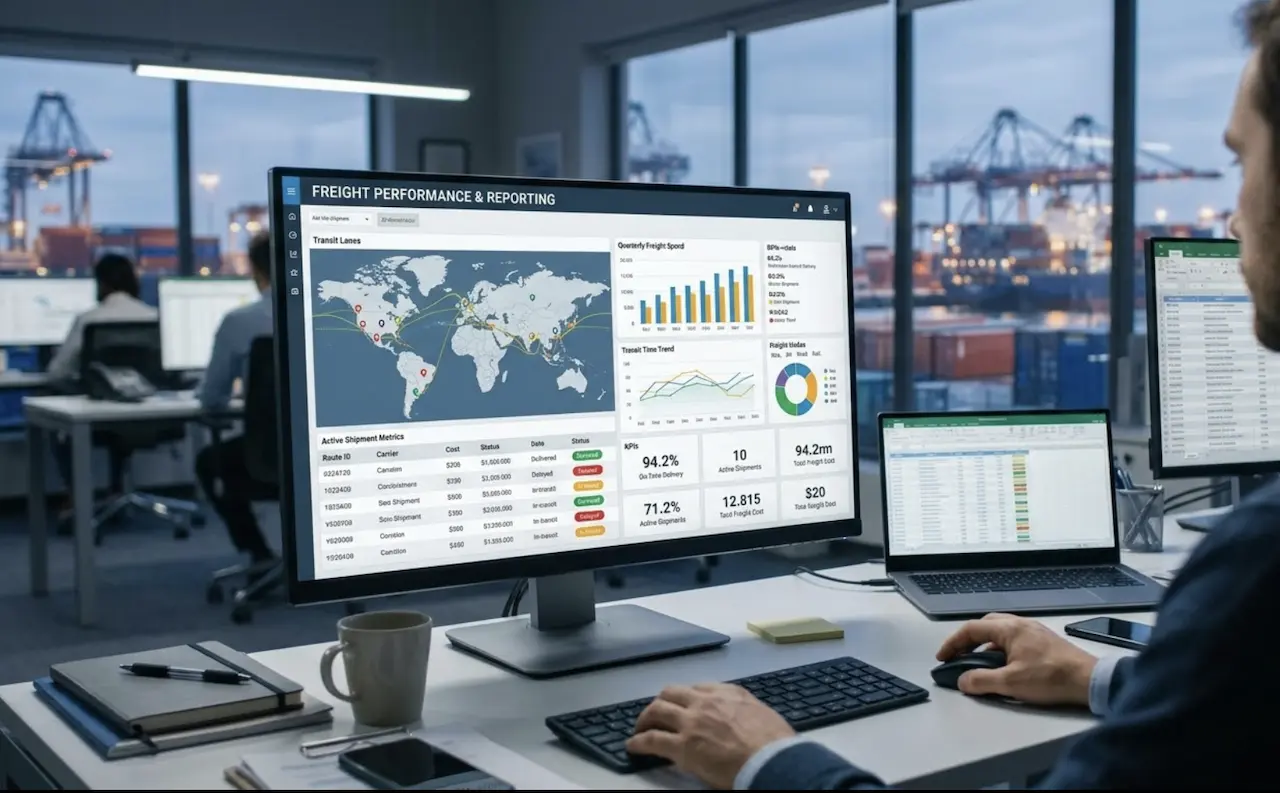
Logistics reporting that stops at a tracking screen tells you where an order is, not whether the network is working. Freight analytics closes that gap by putting cost, service and carrier behaviour side by side.
DSA's reporting and analytics cover the same ground. They include DIFOT measured against carrier ETAs, tracking dashboards, and delivery and cost analysis. Fiscal and operational reports run through DSA's Freight Management System. Operations, finance and procurement read the same numbers, so a conversation about cost and a conversation about service start from one set of facts.
Why monthly, and not at contract renewal
Fuel levies, carrier pricing and capacity all move within a year. Reviewing once, at renewal, catches those changes late.
Take a simple example. Service on one lane starts slipping in March. Nobody sees it until the contract review in November. By then, eight months of invoices have been paid and eight months of late deliveries have reached customers. Monthly reporting shows the same slip in April, while it is still one carrier and one lane.
Monthly is also long enough to mean something. A month of freight gives each lane enough volume to show a pattern. Monthly is also short enough that a decision made on Monday still matters when the next report arrives.
How reporting turns into improvement
On its own, a report improves nothing. The review around it is what changes the numbers. That holds for any supply chain reporting: the value comes from the decisions it prompts. Each cycle is short:
- Numbers go on the table: cost per lane, DIFOT by carrier, invoice corrections and open issues.
- Each exception gets an explanation from the carrier or 3PL involved.
- Actions are agreed, each with an owner and a date.
- Next month's report shows whether they worked.
At DSA, this is the monthly business review that runs alongside day-to-day freight management. Lanes priced above the market can be re-quoted. Any carrier that keeps missing the agreed service level gets a plan to recover, and the freight can move if it does not. Over several months the same report shows whether lanes got cheaper, deliveries got more reliable and your team spent less time chasing.
This is also where rates get handled properly. When a lane sits above the market, the report shows it, and a tender can test it. Rate negotiations stop being a yearly argument and start from lane-level evidence. With a 4PL provider, that cycle covers every carrier and 3PL you use, so the review looks at the whole network instead of one supplier at a time.
Questions to put to your current provider
Five questions show quickly whether reporting is part of the service:
- Can you show cost per lane, with fuel and surcharges separated?
- How did DIFOT look by carrier over the last six months, and where did it slip?
- How many invoice differences were raised last quarter?
- What changed after our last review?
- Who owns the actions that come out of each review?
If the answer to most of them is "we can pull that for you", reporting is not part of the service. Reporting then becomes an extra you have to ask for.
Where this leaves you
Rate still matters, and it matters most when it is tested against evidence, lane by lane, month after month. A free freight profile assessment looks at your current freight profile, carrier performance and pricing. That shows where cost, service and reporting could improve, so you weigh a rate against facts instead of a quote.